Is Moving to Kanagawa Worth It for PR? Tokyo vs Yokohama, in Data
Is moving to Kanagawa worth it for permanent residency? The short answer: for Gijinkoku applicants, mostly no – Tokyo and Yokohama are now only about a month apart. For HSP (incl. deemed; additional-document effects aside), the paper gap is still around 8 months, but how solid those 8 months are deserves three question marks.
Back in April, on rednote (@ad_astra), I gave one verdict on this question: applying as HSP had real value but called for caution; applying as Gijinkoku was not recommended. Two months later, the trends behind that verdict have all changed direction. So this article won't simply issue another verdict; instead it lays out how to judge – numbers expire, but the way to read them doesn't.
Start with where things stand. The chart below compares three forecasts:
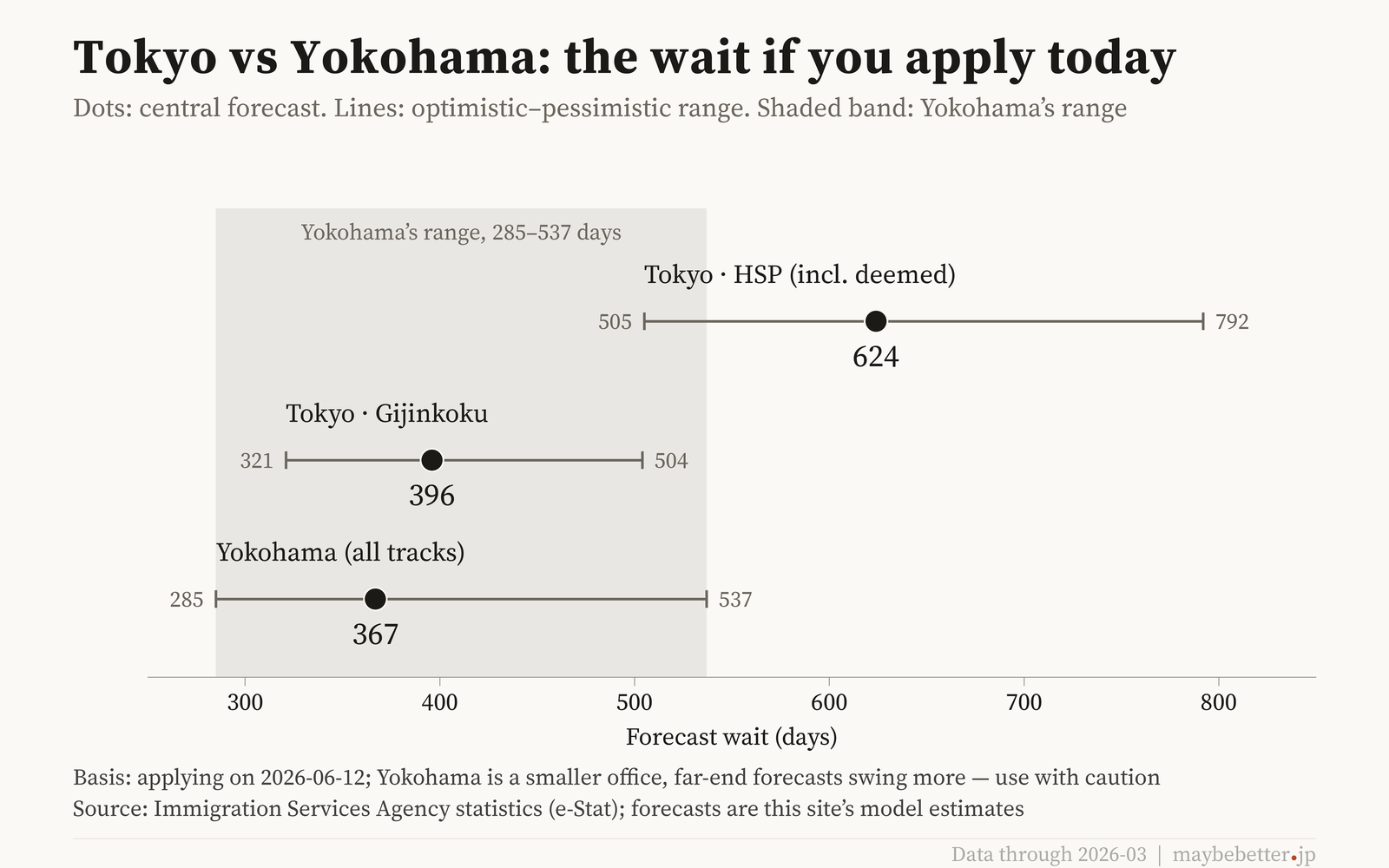
The Gijinkoku case takes one glance. Tokyo 396 days, Yokohama 367 – a 29-day gap, hardly enough to offset the time and cost of moving itself.
More importantly, Yokohama's forecast range (285–537 days) almost entirely covers Tokyo's Gijinkoku range (321–504). Moving to Yokohama isn't necessarily faster – it could even be slower.
April's "not recommended" is now closer to "no point."
Yokohama's speed was a temporary dip
Line up Yokohama's end-of-March backlog year by year, and the shape says more than the numbers:
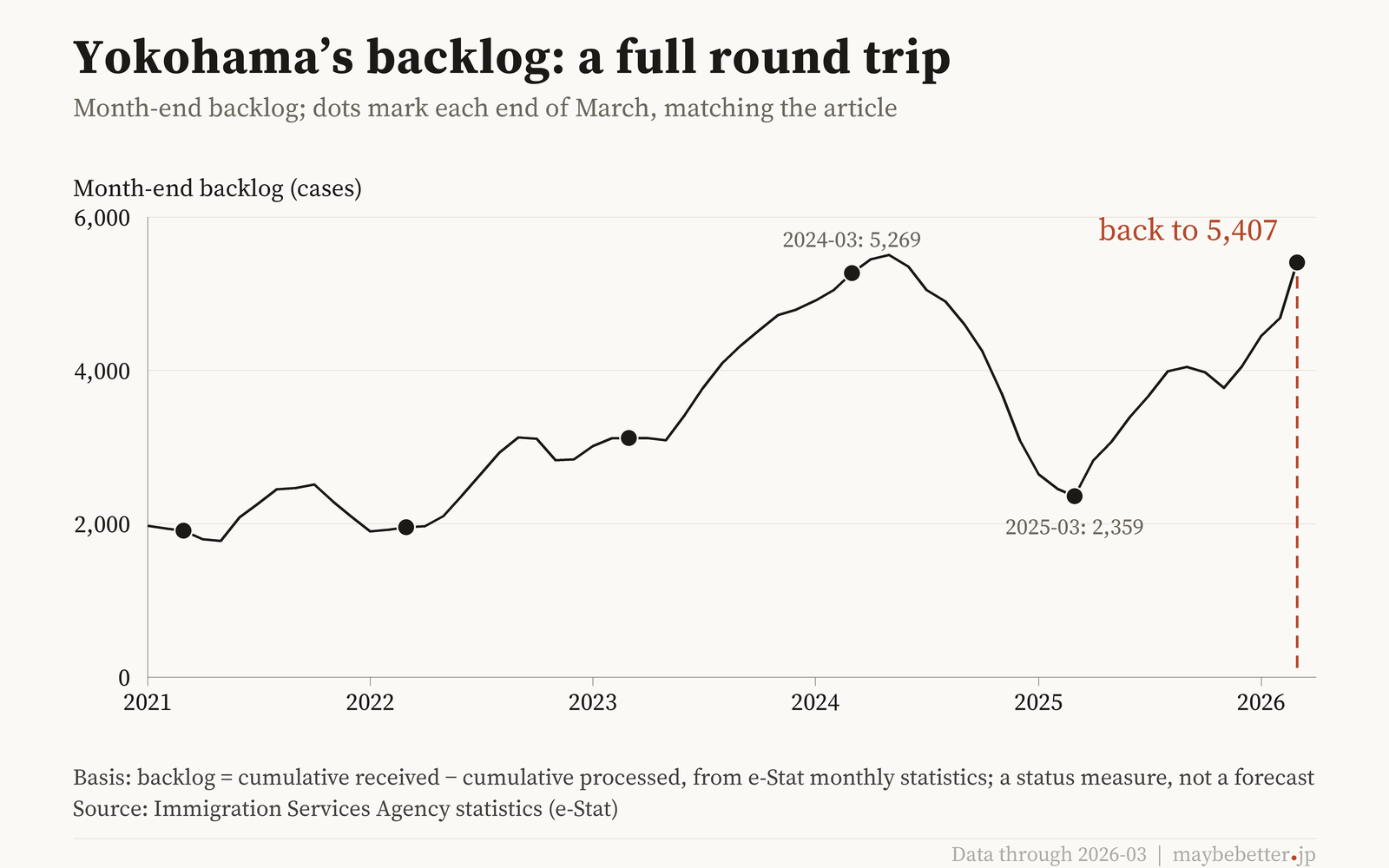
The backlog started piling up in 2023, passed 5,200 cases in 2024, then was cleared down to just over 2,300 in 2025. My April piece was written right at the tail of that dip.
This year the backlog is back to about 5,400 – roughly the 2024 level again. In other words, Yokohama was never inherently fast; it just happened to be a stretch with a short queue.
Today's Yokohama takes in about 900 new applications a month but processes only about 680. The difference of 200-odd cases piles onto the backlog every month, and the slowdown shows no sign of stopping.
Tokyo is moving the other way. Its monthly processing has clearly risen, from just over 2,800 to around 3,300. At the current pace, clearing its backlog would take about 14 months; a year ago, that figure was 21.
Yokohama has gone from about 3 months to about 8. One is speeding up, the other slowing down, and the gap between them is closing.
HSP: how solid are those 8 months?
Back to HSP. The 8-month figure itself is right; the question is how much of it you can count on.
First, Yokohama is still slowing. The backlog climb hasn't stopped, and forecasts can only be computed from data that has already happened – they lag a deterioration in progress.
Second, Yokohama's forecast itself isn't very stable. Its range is wide, at 285–537 days, and the bad case of 537 comes close to Tokyo HSP's good case of 505. The more the two ranges overlap, the more moving becomes a coin flip.
Third, part of those 8 months comes from Tokyo getting slower. Tokyo's HSP track has indeed been slowing – a structural effect of split-track screening (analyzed earlier). But betting a move on "Tokyo will keep getting worse" is itself an extra layer of uncertainty.
So my current take: if you were planning to move to Kanagawa anyway, faster PR screening is a nice bonus. But moving solely to get PR faster is no longer the deal it was.
How to judge for yourself
If you're seriously weighing this, look in this order:
First, check Tokyo and Yokohama separately with the permanent residency wait-time prediction tool at maybebetter.jp. Don't stop at the central estimate – look at the full range.
Second, put the two ranges side by side and see how much they overlap. The bigger the overlap, the less reliable the time saved by moving.
Third, when the monthly data updates, scan two things: when Yokohama's backlog starts falling, and whether Tokyo's processing volume holds. If either changes, redo this math.
A few factual notes to close.
As of this writing, PR applications from Kanagawa fall under the Yokohama branch office. Jurisdiction follows where you live; there is no minimum length of stay, but the residence must be genuine.
After moving, you must file a residence notification at your new municipality within 14 days – usually completed together with the move-in procedure when you present your residence card.
Failing to report a new address for over 90 days without a legitimate reason, or reporting a false address, can be grounds for revoking your residence status.
Forecasts in this article are based on e-Stat data through March 2026; ranges are optimistic-to-pessimistic estimates. Yokohama is a relatively small office and its far-end forecasts swing more – treat them with caution.
Backlog and processing figures are raw e-Stat statistics. "About N months to clear" means the month-end backlog divided by the trailing six-month average of cases processed – a measure of current pressure, not a forecast of your screening time.
If you would like to share your view or your timeline: [email protected]. The numbers here will be updated as things change.