Tokyo PR: why HSP is slower than Gijinkoku, and by how much
Here's the conclusion up front: if you apply for permanent residency in Tokyo through the Highly Skilled Professional track (including the points-based "deemed HSP" route -- "HSP" below), your application will consistently take longer than one filed through a regular work-visa track such as Engineer/Specialist in Humanities/International Services ("Gijinkoku" below). Among Tokyo cases approved in the first half of 2026, the median wait was 638 days for HSP versus 416 days for Gijinkoku -- about 53% slower. And the gap hasn't always been there: it has widened over the past year or two.
This article covers two things: why the gap exists, and how large it is now and how it has changed.
A note on classification first: "HSP" here means applications filed through the Highly Skilled Professional procedure (including deemed HSP), and "Gijinkoku" means applications filed through regular work-visa procedures such as Engineer/Specialist in Humanities/International Services. The classification follows the procedure used at filing, not the residence status itself.
Why: Tokyo doesn't review applications the way other bureaus do
The conclusion: Tokyo is very likely the only bureau that processes HSP and Gijinkoku PR applications in separate tracks -- separate review teams and workflows for each. At every other bureau, both go through a single queue, and the visa track doesn't affect how fast results come out.
Here's how I arrived at that.
When I first noticed that HSP was slower than Gijinkoku in Tokyo, my reading was: HSP applications require verifying the points score, the review is more complex, so processing is slower. If that logic held, HSP should be slower than Gijinkoku at every bureau.
So I collected real cases from other bureaus to see whether they showed the same stable gap -- and if so, how large.
I got more than two hundred real cases for Yokohama. The result was a surprise: HSP and Gijinkoku waits differed by only a few days, and both sat close to the prediction tool's type-agnostic baseline. I then checked a few dozen cases each for Osaka and Nagoya -- same conclusion.
In principle, points have to be verified wherever you apply; per-case complexity is no different from Tokyo. Yet the Tokyo-style gap simply didn't appear.
That's when it clicked: what determines your wait isn't "how hard my application is to review" but "how the queue of hundreds or thousands of people ahead of me is organized."
It's like waiting at a checkout: how long you wait has little to do with what's in your cart, and a lot to do with how the lines ahead of you are set up.
And Tokyo's scale is in a class of its own: over the past six months (October 2025 to March 2026) it processed about 3,300 PR applications per month on average -- roughly half the national total. My inference is that this scale makes Tokyo the only bureau with both the incentive and the capacity to process applications in groups by filing procedure.
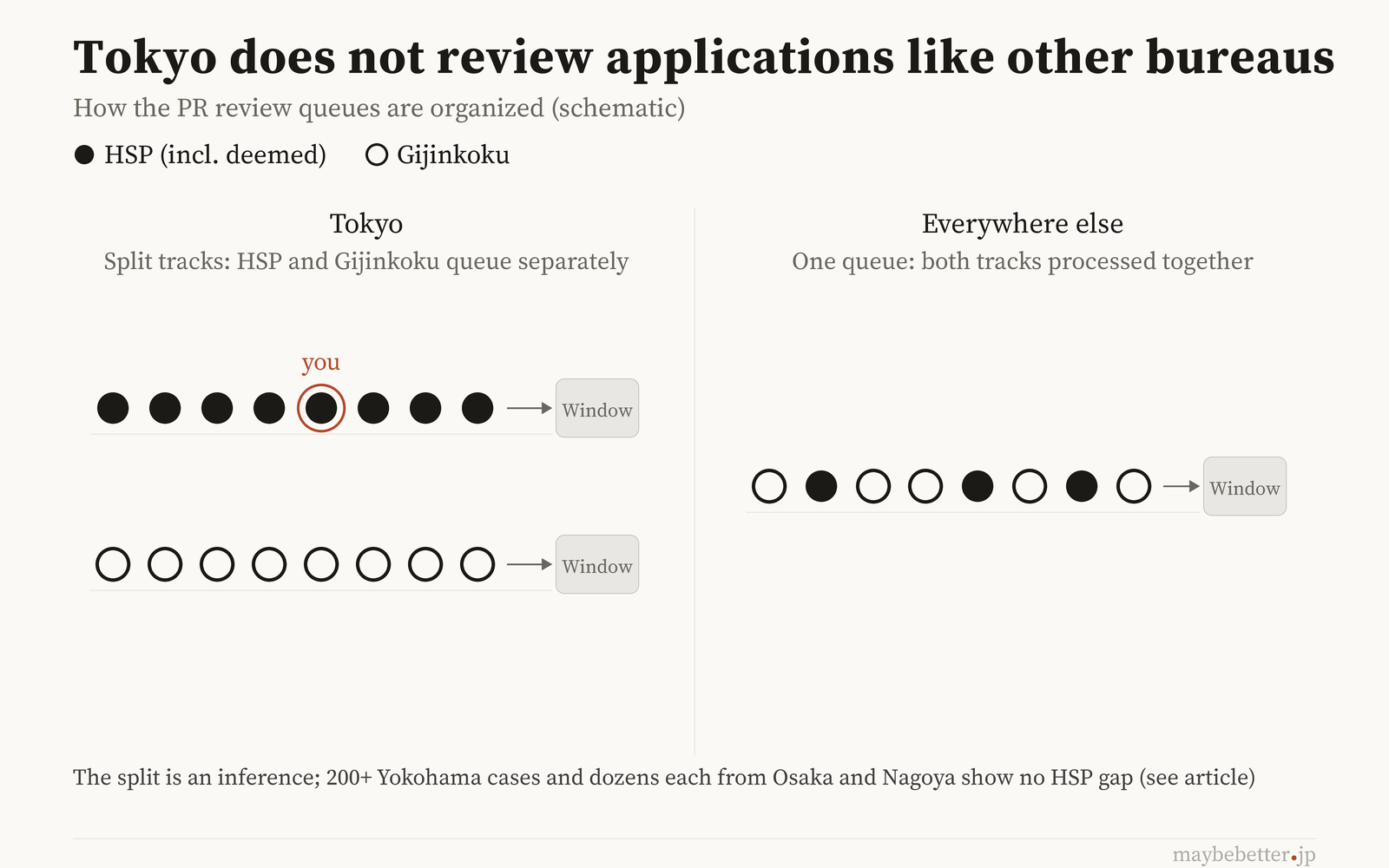
Once applications are grouped, those filed through the HSP procedure stand in a different line from Gijinkoku, and HSP's extra complexity drags down only the HSP line.
At every other bureau, HSP and Gijinkoku flow through one queue. A single officer may have both kinds of applications on their desk at once. So even if an HSP case takes somewhat longer to review, the extra time is spread thinly across the whole queue, and the two tracks end up with nearly identical waits.
Maybe HSP applicants still wait a few extra days in the end -- true. That is precisely the extra time the officer spent reviewing your case.
How much slower: the gap is widening
In late March 2026 I published the first statistics on this gap. In the cases collected at the time, HSP waits clustered around 1.10x the type-agnostic baseline and Gijinkoku around 0.85x -- HSP was close to 30% slower. Those numbers weren't wrong; they faithfully recorded the overall level of the case pool back then.
But slice the cases by approval date and you'll see the gap isn't a fixed ratio -- it's widening. Here are the 50 Tokyo cases approved since 2025:
| Approved | HSP median | Gijinkoku median | Ratio |
|---|---|---|---|
| 2025 H1 | 585 days (1 case) | 533 days (2 cases) | 1.10 |
| 2025 H2 | 576 days (10 cases) | 459 days (3 cases) | 1.25 |
| 2026 H1 | 638 days (28 cases) | 416 days (6 cases) | 1.53 |
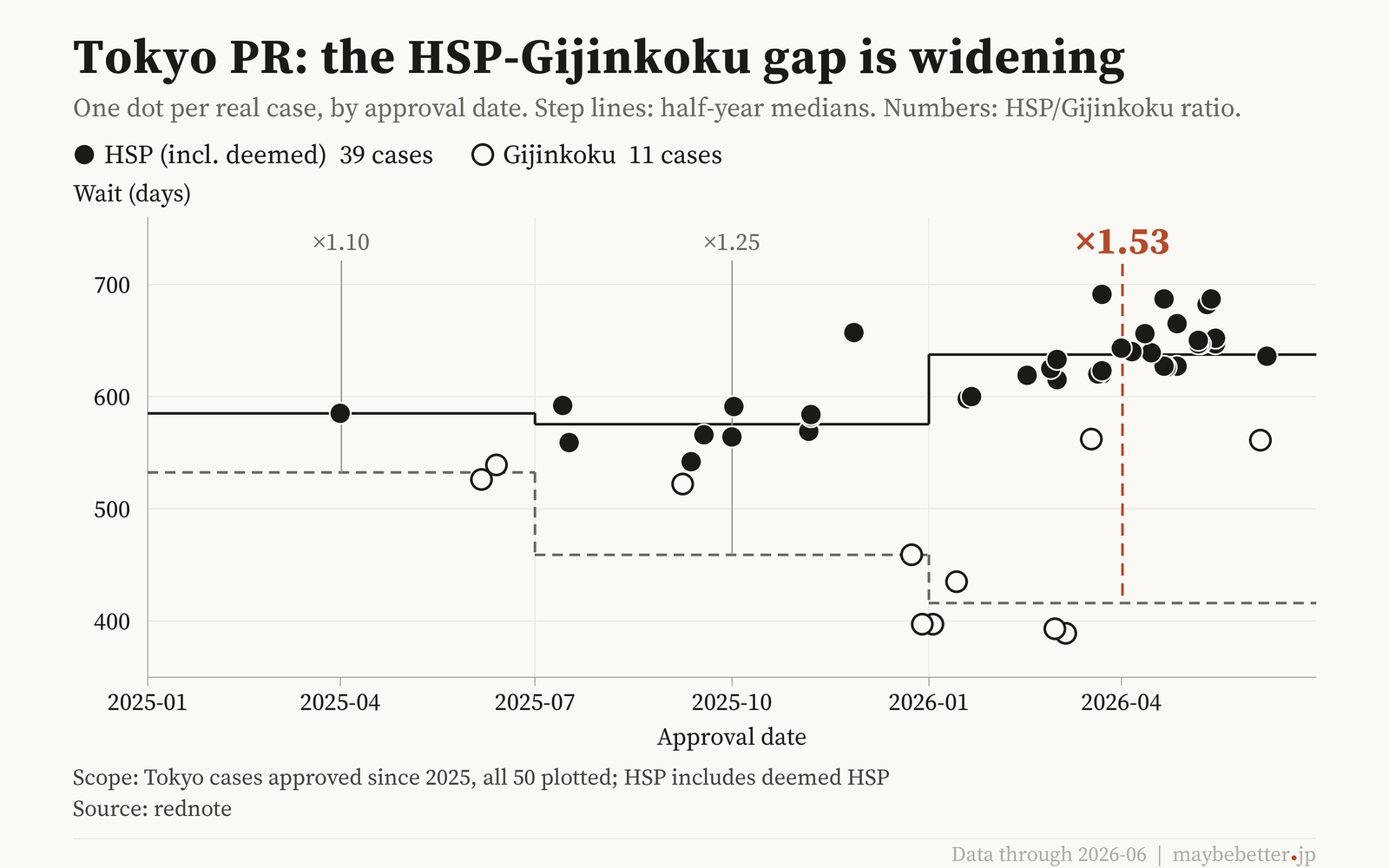
The first two rows have very few cases and only indicate direction; the main support is the 34 cases approved in the first half of 2026. Slicing by application date shows the same trend: cases filed in the second half of 2023 had a ratio of about 1.1, while those filed in the second half of 2024 are already at 1.43.
Everything above has already happened. Extrapolating along this trajectory to today: computed with the permanent residency wait-time prediction tool at maybebetter.jp, applying in Tokyo in June 2026 gives a type-agnostic baseline of about 488 days, about 624 days for HSP, and about 396 days for Gijinkoku -- HSP about 57% slower. Also, the Gijinkoku sample is still small and its median is noisy, so don't take the ratio's decimals too seriously.
What this means for applicants
If you're applying in Tokyo: HSP being slower than Gijinkoku is a structural feature of how reviews are organized, and you shouldn't expect it to fade on its own. Based on the current case calibration, there's no sign of it narrowing in the short term either.
If you're applying outside Tokyo: no need to worry about HSP being slower. Yokohama, Osaka, and Nagoya cases have all been checked -- no observable difference.
Data notes: official statistics are from e-Stat's immigration statistics, with data through March 2026.
The Tokyo sample is the 50 cases approved since 2025; case data for all bureaus comes from reports shared publicly on rednote.
This analysis was first published on rednote (@ad_astra).
If you'd like to share your own timeline (application date, approval date, bureau, filing track), email [email protected]. I'll update the numbers in this article as new cases come in.