Japan PR Rejections: 6 Common Reasons and When You Can Reapply
Japan has been tightening its policies toward foreign residents since 2024, and permanent residency (PR) screening is clearly stricter; a single flaw in your record can lead to a rejection. Tokyo stands out: the main immigration office rejected 60.7% of the PR applications it decided between October 2025 and March 2026, up from 21.8% in January–August 2024.
I went through the PR rejection experiences publicly shared on rednote, 21 cases in total, and sorted them into the chart below: six common rejection reasons, by how often they appear and how long you wait before reapplying.
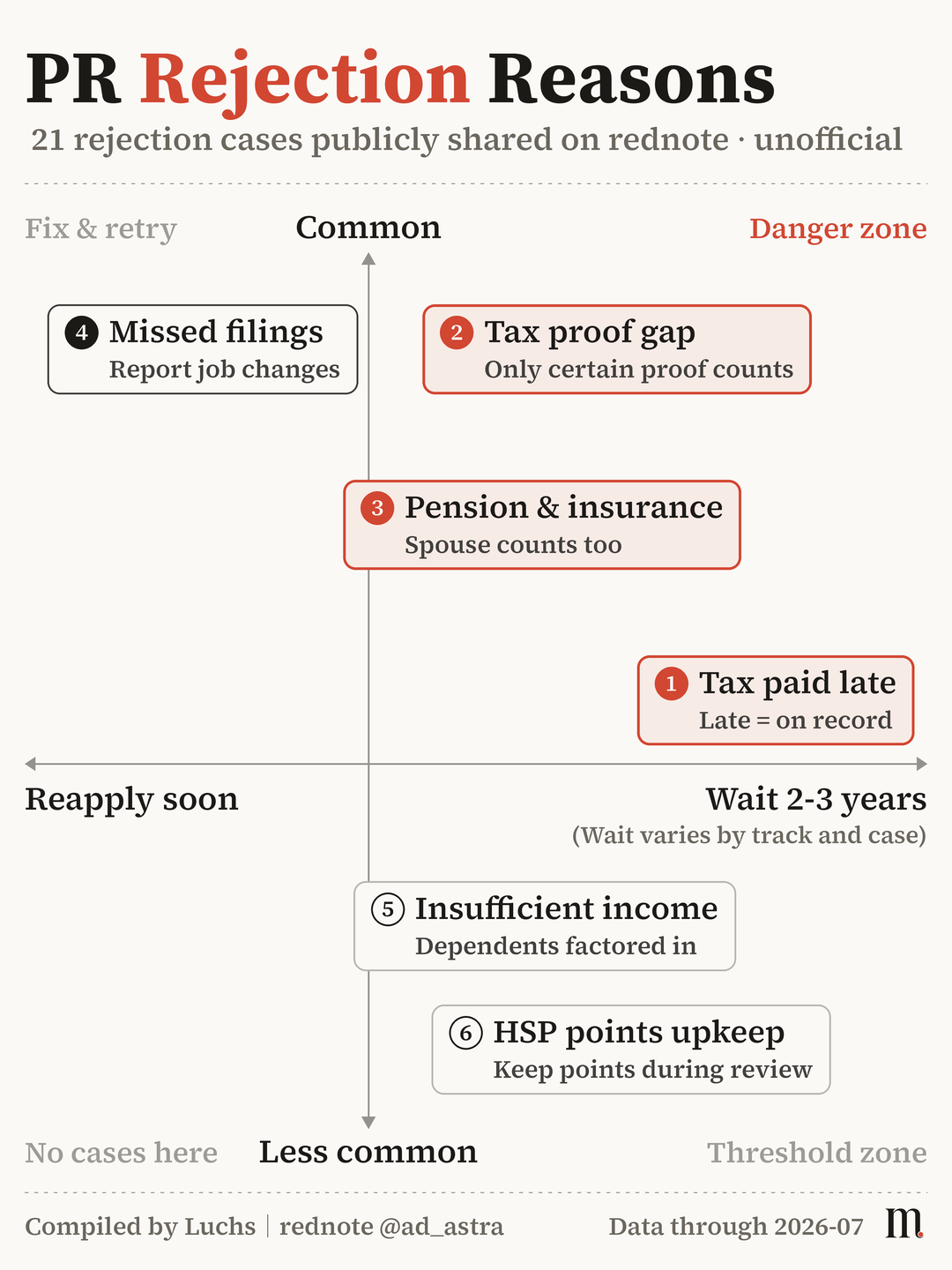
The top-right danger zone is both frequent and slow to recover from; the two resident-tax items and pension/health insurance all land there. Below, each reason in chart order: the official basis, real cases, and what to check. I've kept the officers' explanations from the rejection hearings as close to the original as possible.
① Resident tax: late payment
Paying after the deadline can leave a late-payment record, even if no penalty fee was charged.
When applying for PR on a work visa, you generally submit the last 5 years of resident tax certificates (kazei/hikazei shomeisho and nozei shomeisho), plus documents proving the tax was paid on time (bank book copies, receipts, etc.). For the Highly Skilled Professional routes, it's the last 3 years on the 70-point route and the last 1 year on the 80-point route. (Source: Immigration Services Agency, required documents for PR applications, lists 3 and 4.)
Cases:
- A single late resident-tax payment; a letter of explanation was attached at submission, but the application was still rejected. The officer's explanation at the hearing: reapply after 2 years.
- A one-month late payment two years before the application date; the review took 16 months with one round of additional documents, and still ended in rejection. Officer's explanation: gather complete documents and build a longer stable record before reapplying.
What to check: set up special collection (salary deduction) or automatic bank transfer if you can; it stops late-payment records from arising at all.
② Resident tax: missing proof
Even if you paid on time, you need to prove it in a form immigration accepts.
Official requirements divide resident-tax documents into two types: (a) the tax and payment certificates, and (b) documents proving payment was made on time (bank book copies, receipts, etc.). If your entire period was under special collection (salary deduction), type (b) isn't needed; for any period outside special collection, you must submit type (b) for that period. (Source: Immigration Services Agency, required documents list 3.)
Cases:
- Asked to submit payment receipts (ryoshusho) from several years back that hadn't been kept; the ward office issued a certificate of on-time payment, but it wasn't accepted due to formal issues such as missing official seals and anti-forgery features. Officer's explanation: reapplication is possible right away, but credible proof must be attached.
- Payment receipts from 4 years earlier were lost; only a letter explaining the tax had been paid within the deadline was submitted. It wasn't accepted; the rejection notice arrived after 895 days of review.
What to check: for periods of ordinary collection (paying yourself), receipts must prove the specific payment date and carry official-seal validity.
③ Pension & health insurance
It's not just your own record. A spouse's missed or late payments can also affect the main applicant.
When applying on a work-type visa, you submit payment-status documents for the public pension and public health insurance systems you were enrolled in over the past 2 years. For pension, acceptable records include those issued by the pension office, nenkin teikibin statements, or the monthly records from Nenkin Net. If you had National Pension (kokumin nenkin) periods within the past 2 years, copies of the payment receipts for those periods are also required, with a letter of explanation if they're hard to provide. (Source: Immigration Services Agency, required documents list 3.)
Cases:
- After marriage, the spouse was not promptly enrolled in National Pension and National Health Insurance; back payments were made but the delinquency record remained, and the application was rejected. The applicant's own income was fine. Officer's explanation: clear the spouse's delinquency record, then reapply in August of the same year.
- The pension office confirmed "records fine, no late fees," yet the application was rejected citing pension. What immigration checks may not be whether late fees exist, but whether any payment went past its deadline.
What to check: start with whether you or your spouse have any gaps, non-enrollment, or late payments in pension or health insurance.
④ Missed notifications
Leaving a job, starting a new one, changes to your employer's name or address: all of these must be reported to immigration.
For work visas, changes such as the contracting organization's name or address, contract termination, or the conclusion of a new contract require a "notification concerning the contracting organization" within 14 days. (Source: Immigration Services Agency, Q&A on notifications concerning affiliated organizations.)
Cases:
- Changed jobs on an HSP visa without re-obtaining HSP status, which put the visa status in question; rejected. Officer's explanation: renew the HSP visa, then reapply.
- Moved jobs with no gap but never filed the notification; all other conditions were met, still rejected. The officer's guidance was conservative: wait until 5 years at the new employer before reapplying. In similar cases, filing the missed notification was usually enough.
- The employer relocated and the address-change notification was never filed; rejected. Officer's explanation: file the change, then reapply.
What to check: after leaving or joining a company, or any change to the employer's name or address, file the notification within 14 days. Past filings can sometimes be checked via a personal-information disclosure request to the regional immigration office.
⑤ Insufficient income
Income isn't judged against a single fixed number; it's weighed together with the number of dependents and household structure.
One of the statutory requirements for PR is having "sufficient assets or skills to make an independent living." The official guidelines describe this as not becoming a public burden in daily life, with stable prospects for the future in view of one's assets and skills. No official income threshold is published; the figures below come from cases and practitioner accounts, not from any official standard. (Source: Immigration Services Agency, Guidelines for Permanent Residence Permission.)
Cases:
- Income for two fiscal years was flagged. The pandemic year was deemed "understandable," but the other year "could not be justified." At the hearing, the applicant was told the current benchmark is roughly 3.5–4 million yen, based on income before tax and social-insurance deductions; the past 5 years are what mainly count, so a later raise submitted as supplementary material didn't change the result. This was a verbal, case-specific explanation, not an official standard.
- Another case had no hearing; with dependent deductions (380,000 yen per person), the remaining income was about 2.6 million yen, so income is presumed to be the reason. This is an outside inference; treat it as reference only.
What to check: roughly estimate whether your income supports an independent, stable living, factoring in your number of dependents.
⑥ HSP points maintenance
If your Highly Skilled Professional points drop below the threshold during the review period, that alone is a rejection risk.
The HSP routes require point calculation sheets for both the application date and a past reference date: the application date and 1 year prior on the 80-point route; the application date and 3 years prior on the 70-point route. (Source: Immigration Services Agency, required documents list 4.)
Cases:
- After submitting, 4 months of parental leave lowered the applicant's income bracket below 80 points; rejected. Officer's explanation: keep your points up after applying. The longer the review drags on, the more chances immigration may have to check.
- In another case, the applicant was told that if points drop and later recover, the 1-year or 3-year clock restarts from the recovery date.
What to check: stay stably above 70/80 points at the application date, at the past reference date, and in the projected future.
If you know of a rejection reason not covered here, email me at [email protected]. If common, easy-to-hit patterns come up, I'll update this article.
This article was first published on rednote (@ad_astra).
Rejection-rate methodology: computed from the case-disposition breakdown in e-Stat's Immigration Control Statistics, Table 06, as rejections ÷ (approvals + rejections); Tokyo main office = Tokyo jurisdiction − Narita Airport Branch − Haneda Airport Branch − Yokohama Branch.
About the cases: the 21 cases are compiled from rejection reports publicly posted on rednote; they are self-reported and cannot be individually verified. Not official statistics.
Data through March 2026 (e-Stat); case collection as of July 2026.
Wait-time estimates for each bureau are available from the permanent residency wait-time prediction tool at maybebetter.jp, built on the same e-Stat data and updated monthly.