How Long Do Additional Document Requests Delay Japan PR? 60 Tokyo Cases
Does a request for additional documents slow down your Permanent Residency application in Japan — and if so, by how much? It's a common worry among applicants waiting for results, but a clear, quantified answer has been hard to find.
Here is the short version: based on 60 real cases from the Tokyo Regional Immigration Bureau, one request for additional documents adds a median of about 26 days to the wait. The rest of this article explains where that number comes from.
Plenty of individual cases are shared publicly, yet the answer stays murky for two reasons. First, people apply at different times, so the baseline processing time differs from the start. Second, there is individual variance: two people who applied on the same day and went through exactly the same process can still get their results at different times. Combined, these two effects bury the impact of additional documents in noise.
This article removes both.
The chart below compares actual waiting times against predictions from the permanent residency wait-time prediction tool at maybebetter.jp. The tool estimates the baseline waiting time for each application date and visa type, so comparing the actual wait against it strips out the timing effect.
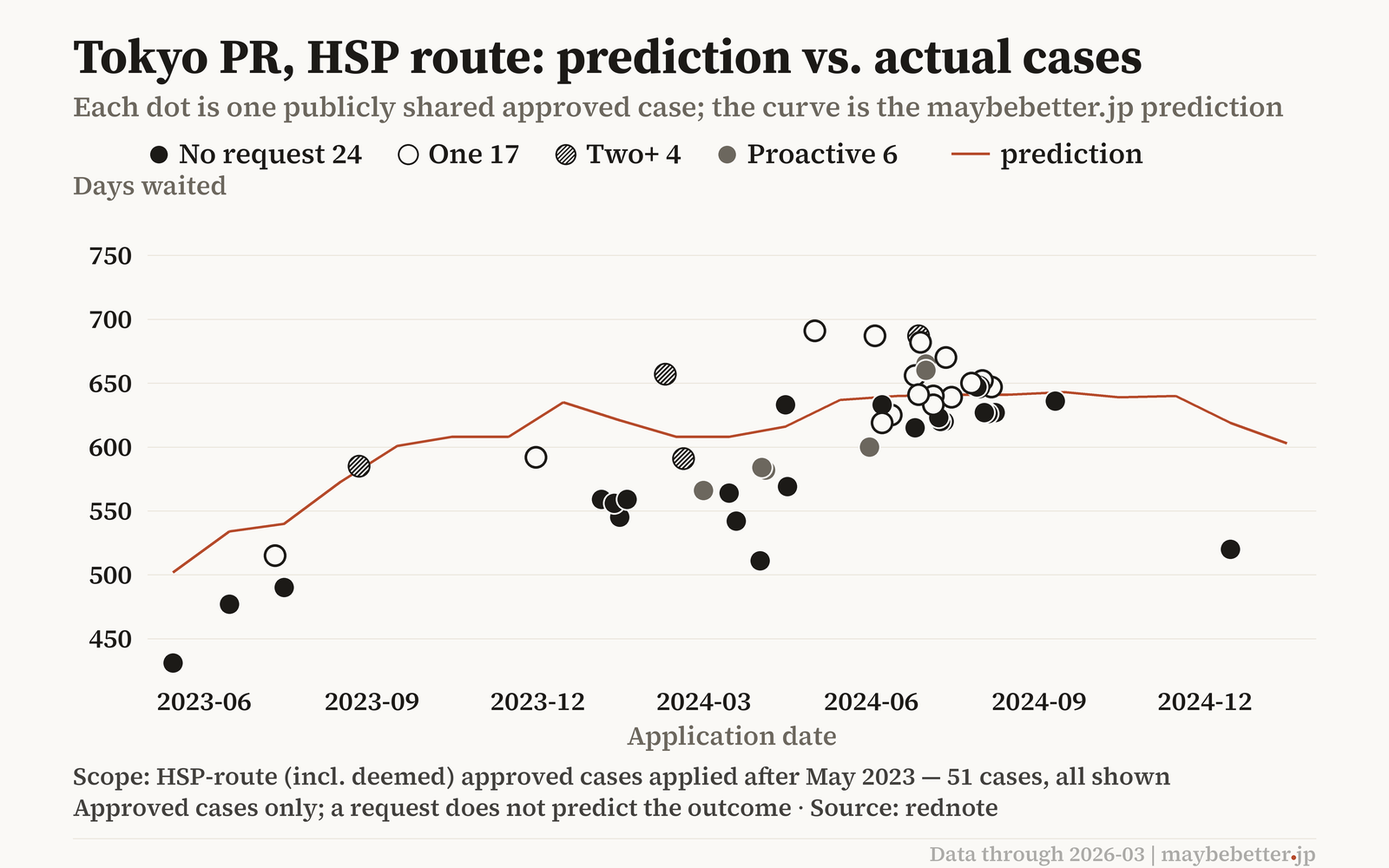
Next, the standardized results are split into three groups — no request, one request, two or more requests — and compared by median, which cancels out most of the individual variance. What remains, the gap between groups, is the effect of the document requests themselves:
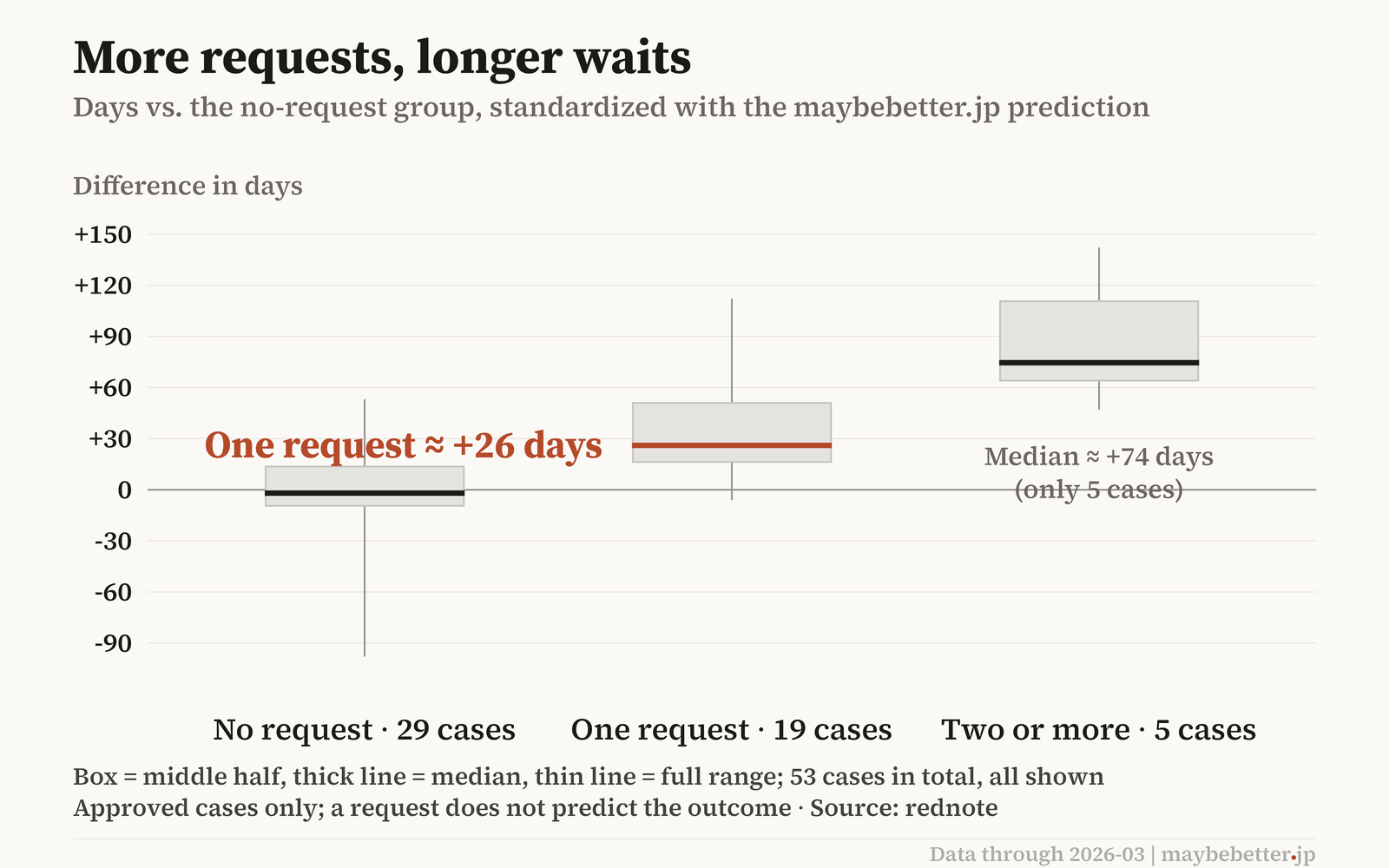
Three conclusions hold up reasonably well:
One request for additional documents adds a median of about 26 days. Half of the cases fall between +16 and +51 days.
What about sending extra documents on your own initiative? Based on the available cases, if it does not change the number of requests you receive, there is no clear effect either way.
Two or more requests bring much larger delays and much more uncertainty — the median in this sample is about two and a half months, but there are only five such cases. That said, cases that draw repeated requests tend to be complicated to begin with and would take longer anyway; the delay is not necessarily all due to the documents.
One caveat: these conclusions rest mainly on Highly Skilled Professional (points-based) cases — computed separately, the HSP median is about 24 days, nearly identical to the overall figure. There are still too few cases on the regular work-visa route to draw separate conclusions.
To estimate how much longer your own application might take, you can enter your application date and visa type into the permanent residency wait-time prediction tool at maybebetter.jp.
Data and method
The cases come from publicly shared PR approval timelines, all under the Tokyo Regional Immigration Bureau — 60 in total (29 with no request / 19 with one request / 5 with two or more / 7 proactive submissions).
The statistics run through March 2026.
Each case was first standardized against the prediction tool's baseline, and group medians were then compared.
The main findings were first published on rednote (@ad_astra) on June 3, 2026, based on 34 cases; expanding to 60 cases did not change the main conclusions.
If you are willing to share your own timeline (application date, result date, and whether documents were requested), it will make these estimates more accurate for future applicants: [email protected].